
Appearance
Symbols and markers
Two layer types the plugin adds, both of which draw a shape rather than a dot. One is per row of a query; the other is a handful of handles you drag.
symbol
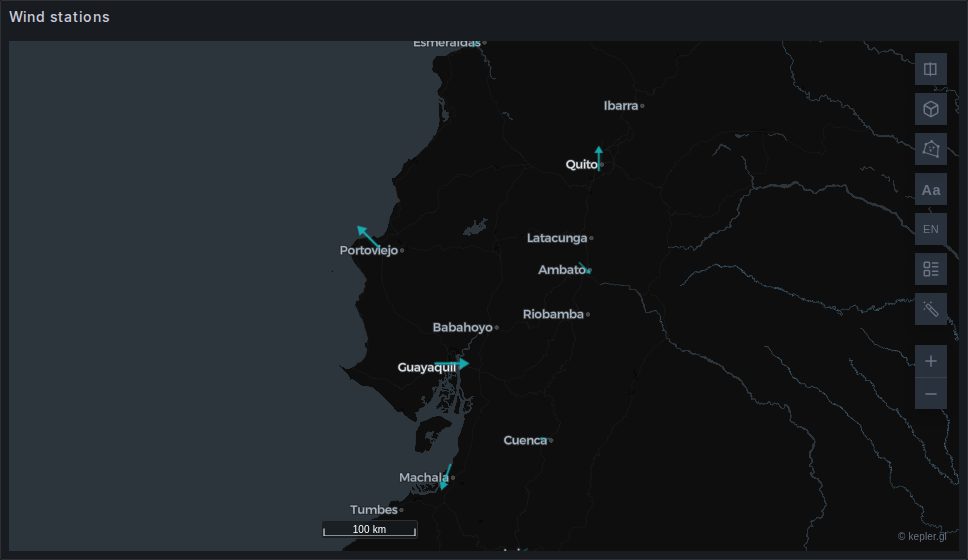
sql
SELECT station        AS name,
       lat            AS latitude,
       lon            AS longitude,
       wind_speed,
       wind_direction
FROM observations;
Built automatically from a position and a numeric bearing — bearing, heading, course, cog, track, azimuth, orientation, or a wind direction. One mark per row, turned to the column's degrees, and the Point layer kepler would have guessed from the same coordinates is removed rather than left underneath it.
Over a thousand shapes are available: the plugin's own arrow, circle, square and triangle, plus Maki's 215, Temaki's 556 and 272 of the UN OCHA Humanitarian Icons — all CC0, all bundled, none fetched at runtime. The picker sorts them into sixteen themes and opens on the one in use.
The layer's own panel carries the rest: size fixed or by column, outline, drop shadow, a gradient that lightens each symbol towards its tail, upright symbols for a tilted view, labels from any column, and thinning that drops the marks which would overlap at the current zoom.
It can also draw a picture per row instead of a shape — a logo per operator, a photograph per site — loaded through an ordinary <img> so it works under a strict Content-Security-Policy.
See Symbols.
A wind is read differently from a course
Meteorology names a wind by where it comes from; everything else names where it is going. The layer reads a wind direction the first way and a bearing the second, and the convention can be set explicitly. Get it wrong and the whole fleet points backwards — which reads as bad data rather than as a setting.
markers
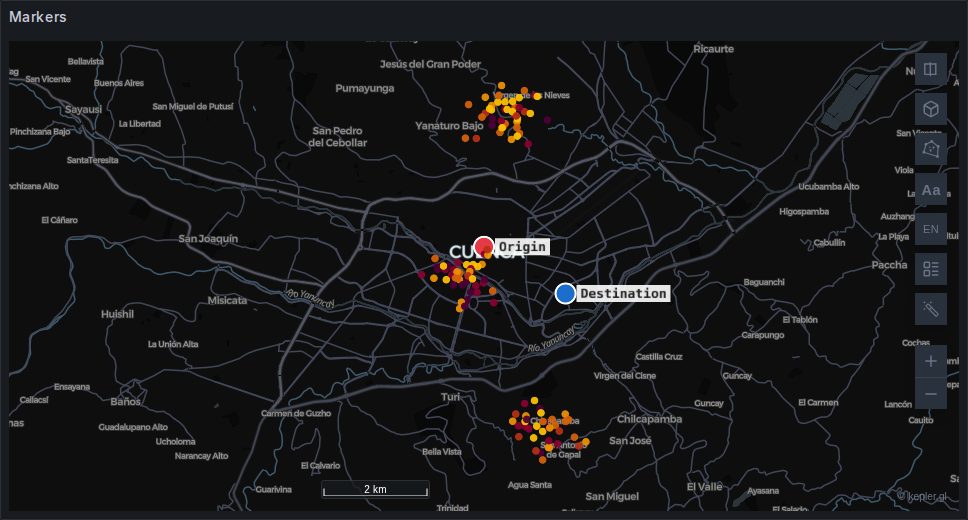
Never built automatically, and it draws nothing from its dataset. Add it by hand, then add as many markers as you need: each one is a draggable point bound to a pair of dashboard variables.
Dropping a marker writes its pair once, on release, so a query hanging off it — an isochrone, a radius, a route — runs once per gesture. The variables are the source of truth, so a marker also moves when the pair arrives from a text box or a shared link.
See Markers.
Which of the two you want
| You want | Layer |
|---|---|
| a mark per row, turned by what the query says | symbol |
| a handle the reader drags, feeding a query | markers |
| a mark per row with no bearing, and no icon | point |
| the flow through a grid rather than the marks on it | Streamlines or vector field |